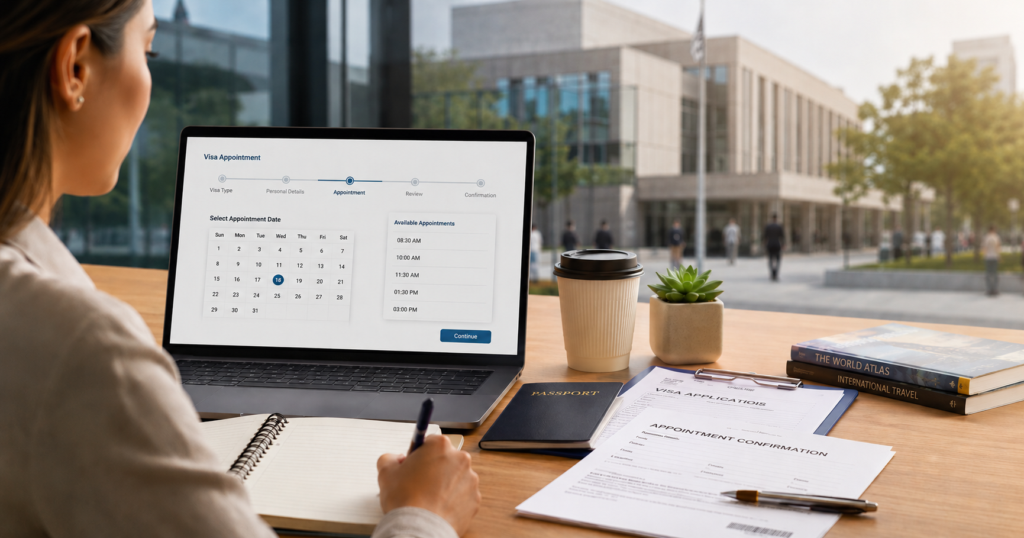
Many people assume U.S. visa appointments are scheduled manually by embassies one by one. In reality, the system is far more structured — and often far more confusing — than most applicants expect.
Understanding how visa appointments actually work can help you:
- better understand wait times,
- avoid common mistakes,
- reduce unnecessary stress,
- and improve your overall planning strategy.
This guide explains the U.S. visa appointment system in plain English, including how appointment slots are released, why some embassies move faster than others, and what really happens behind the scenes.
Step 1 — Determine Your Visa Type
Before you can schedule an appointment, you first need to determine which visa category applies to your situation.
Common nonimmigrant visa categories include:
- B1/B2 — tourism and business travel
- F-1 — students
- J-1 — exchange visitors
- H/L/O/P — petition-based employment visas
- K-1 — fiancé visas
Different visa types may:
- use different processing systems,
- require different documentation,
- have different interview requirements,
- and experience different wait times.
For example, student visas are often prioritized seasonally before academic terms begin, while tourist visa demand may fluctuate more heavily around holidays and travel seasons.
Official U.S. Department of State visa information is available here:
Step 2 — Complete The Required Application
Most temporary visa applicants complete the DS-160 online application form.
This form collects:
- personal information,
- travel history,
- employment details,
- education information,
- and security/background questions.
After submission, applicants receive a confirmation page that is required for appointment scheduling and interview processing.
Official DS-160 portal:
Some petition-based visas may also involve separate USCIS petition approval before embassy scheduling becomes possible.
Step 3 — Pay The Visa Fee
Most U.S. visa categories require payment of a Machine Readable Visa (MRV) fee before appointments can be scheduled.
Fee payment methods vary by country and may include:
- online payment,
- bank deposit,
- mobile payment systems,
- or local partner institutions.
In many countries, payment activation is not immediate. Some systems may take several hours or even multiple business days before applicants can access scheduling calendars.
This delay alone causes confusion for many first-time applicants.
Step 4 — Create A Visa Appointment Profile
Applicants then create an account through the scheduling system used by the embassy or consulate handling their case.
Depending on the country, this may involve:
- the U.S. Travel Docs platform,
- CGI Federal scheduling systems,
- embassy-specific portals,
- or regional visa contractors.
These systems are used to:
- schedule appointments,
- reschedule appointments,
- track interview availability,
- manage document delivery,
- and receive appointment notifications.
Because scheduling systems vary by region, the user experience can differ significantly from one country to another.
Step 5 — Select An Embassy Or Consulate
Applicants usually schedule interviews at:
- a U.S. embassy,
- or a U.S. consulate.
Some countries only have one interview location, while others have multiple.
Wait times can vary dramatically between locations due to:
- staffing levels,
- political conditions,
- local demand,
- security considerations,
- seasonal surges,
- and operational capacity.
In some regions, nearby countries may show very different wait times despite geographic proximity.
Current wait times by location can be explored through Visa Wait Hub’s embassy database and global reporting tools.
Step 6 — Wait For Available Appointment Slots
This is the stage where many applicants become frustrated.
Embassies do not simply offer unlimited appointments every day. Instead, appointment availability is controlled through a combination of:
- staffing capacity,
- security procedures,
- interview volume,
- physical interview windows,
- local operating conditions,
- and internal scheduling policies.
Some embassies release appointments:
- gradually,
- in batches,
- seasonally,
- or unpredictably.
Others may temporarily show:
“No Appointments Available”
This does not always mean interviews are permanently unavailable. It may simply mean:
- current slots are full,
- future batches have not yet been released,
- or scheduling inventory is temporarily paused.
This is one reason wait times can fluctuate significantly over time.
For additional insight into changing wait times, see:
- “Why Visa Wait Times Change (And What It Means)”
Step 7 — Attend Biometrics (If Required)
Many applicants must complete biometrics collection before the interview itself.
Biometrics appointments may involve:
- fingerprints,
- digital photographs,
- and identity verification.
In some countries, biometrics occur:
- at a separate Visa Application Center (VAC),
- before the embassy interview date.
In others, biometrics may occur directly at the embassy or consulate.
The exact process varies by country and visa type.
Step 8 — Attend The Visa Interview
At the interview, a consular officer reviews:
- your application,
- supporting documents,
- travel purpose,
- financial situation,
- and eligibility under U.S. immigration law.
Interview length varies significantly. Some interviews last only a few minutes.
Approval is never guaranteed, even after long wait periods.
Possible outcomes include:
- approval,
- refusal,
- administrative processing,
- or additional document requests.
Step 9 — Visa Issuance Or Additional Processing
If approved, the visa is usually printed and returned through:
- courier delivery,
- pickup locations,
- or embassy retrieval systems.
However, some cases enter:
- administrative processing,
- security review,
- or additional verification procedures.
This can add days, weeks, or occasionally months to the overall timeline.
Why Wait Times Differ So Much Between Countries
One of the biggest misconceptions about the U.S. visa system is that all embassies operate at roughly the same speed.
In reality, wait times are influenced by many factors, including:
- local demand,
- staffing levels,
- political instability,
- regional security concerns,
- student travel seasons,
- tourism surges,
- and operational backlogs.
This is why some embassies may offer appointments within weeks while others may show delays lasting many months.
Visa Wait Hub tracks these patterns globally to help users better understand changing conditions over time.
Final Thoughts
The U.S. visa appointment system is complex, highly regionalized, and constantly changing. Understanding how the process works behind the scenes can help applicants plan more effectively and avoid common misunderstandings.
Although wait times often receive the most attention, the broader scheduling system involves many moving parts that vary by embassy, visa category, and time of year.
Learning how these systems operate is one of the best ways to reduce confusion and make more informed decisions during the visa process.
Related Reading
- Why Visa Wait Times Change (And What It Means)
- Why Some U.S. Embassies Have No Available Appointments
- How To Get An Earlier U.S. Visa Appointment
- How Visa Appointment Cancellations Work
Disclaimer
Visa Wait Hub is an independent informational platform and is not affiliated with the U.S. government or any embassy, consulate, or immigration authority.
This article is provided for general educational purposes only and does not constitute legal advice. Immigration laws and visa procedures can change frequently. For official guidance regarding your specific case, consult the U.S. Department of State, USCIS, or a qualified immigration attorney.